Ten
Years
of
the
Faith
Covenant
An independent evaluation by


About this research
This evaluation was undertaken by the Centre for Inclusive Evaluation and Coventry University, on behalf of FaithAction and the All-Party Parliamentary Group on Faith and Society.
The research was led by Dr Dan Range and Dr Aurélie French, who have extensive experience designing and delivering evaluations that combine robust research methods with practical insight into how programmes operate in real-world settings.
The Faith Covenant
The Faith Covenant is a framework designed to strengthen collaboration between faith communities and local authorities. The Covenant was developed in recognition of the role that faith communities already play in addressing social challenges and social wellbeing across the UK. Faith organisations are often involved in delivering or supporting activity related to public health, social care, education, employment support and community inclusion and the Faith Covenant was created to enable faith-based organisations to work more closely with local authorities in responding to social need. As a flexible framework, the Covenant invites local authorities and faith communities in each area to develop locally appropriate commitments, reflecting local priorities and circumstances.
The first Faith Covenant was signed by Birmingham City Council in December 2014. Since then, the Covenant has been adopted by 33 local authorities across the UK, covering a combined population of more than 12 million people. In June 2024 shortly before becoming Prime Minister, the Leader of the Labour Party, Sir Keir Starmer, wrote to faith leaders across the UK recognising the contribution of faith-based organisations to communities and public life. In the letter he highlighted the role that local Faith Covenants can play in strengthening partnerships between local authorities and faith groups and expressed support for promoting them as a mechanism for collaboration at community level.
Several organisations have played important roles in developing and supporting the Covenant.
The All-Party Parliamentary Group (APPG) on Faith and Society was instrumental in drafting the original Covenant framework and promoting its adoption among local authorities and faith communities.
FaithAction – a national organisation which delivers projects, undertakes research and represents the interests of faith-based organisations within national policy discussions – has supported the development and implementation of the Covenant, not least in their role as secretariat to the APPG.
This evaluation
The purpose of the evaluation is to independently assess how the Covenant has operated in practice since its introduction and to evaluate the difference it has made to collaboration between faith communities and public bodies, grounded in the understanding that effective collaboration better serves their communities.
In doing so, the research seeks to provide a clearer understanding of the Covenant’s contribution to partnership working and to identify lessons that can inform its future development.
The evaluation was designed around the following key aims and objectives:
- Document and analyse implementation approaches, examining how the Covenant has been adopted and implemented across different local contexts since signing.
- Assess impact on policy and practice, including the ways in which the Covenant has influenced collaboration, governance and partnership working between faith communities and statutory bodies.
- Identify limitations and areas for improvement, drawing on evidence from stakeholders involved in Covenant activity.
- Synthesize findings for wider application, identifying lessons that may inform policy and practice across the public sector.
Alongside these objectives, the evaluation was also designed to capture practical learning from Covenant areas in order to better understand how the framework operates in practice. In addition to assessing the Covenant’s impact to date, the research therefore sought to document the experience of those directly involved in its development and delivery, with a view to identifying insights that may inform future implementation.
This work forms part of a wider research initiative supported by the Sir Halley Stewart Trust examining ten years of the Faith Covenant and its contribution to collaboration between statutory bodies and faith communities in the UK. The project aims to strengthen the evidence base surrounding the Covenant and to capture learning from its implementation across different local contexts, helping to inform future policy discussions and cross-sector partnership working involving faith communities.
Download Ten Years of the Faith Covenant
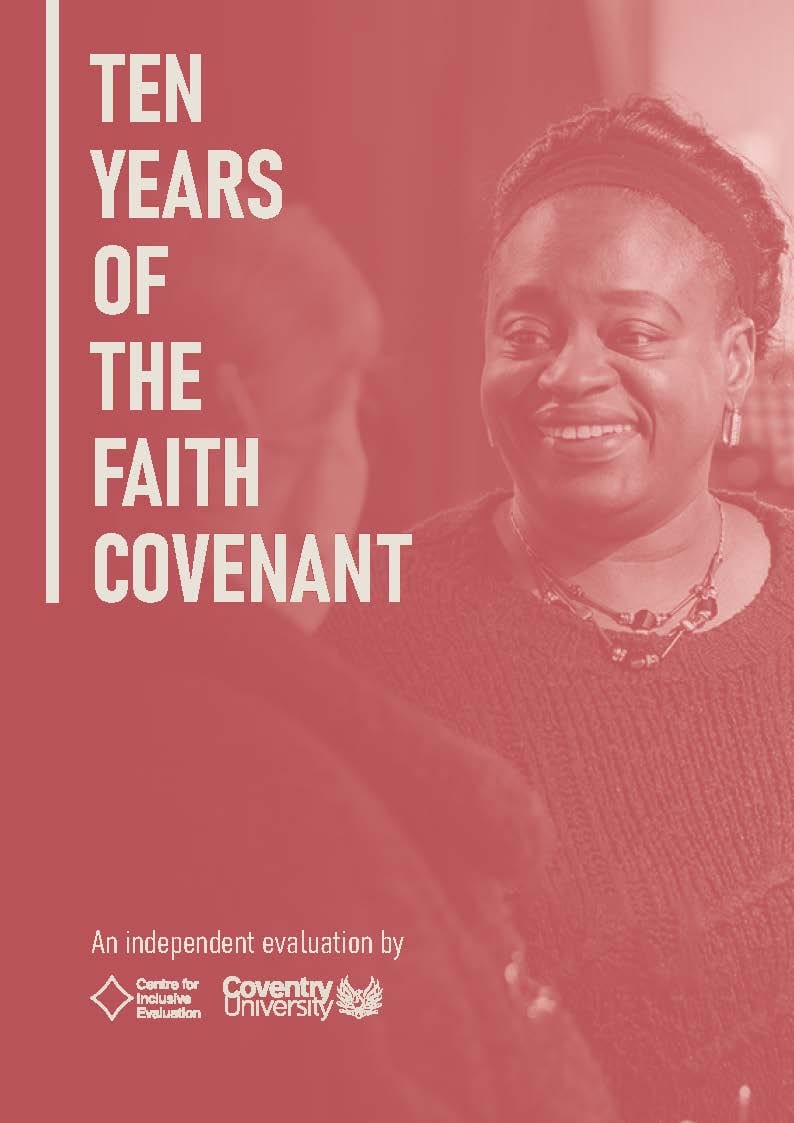
Ten Years of the Faith Covenant
This project has been funded by

This work was undertaken by The Centre for Inclusive Evaluation and Coventry University, on behalf of FaithAction and the APPG for Faith and Society. The views expressed within this report are those of the authors and not necessarily those of the Sir Halley Stewart Trust.